
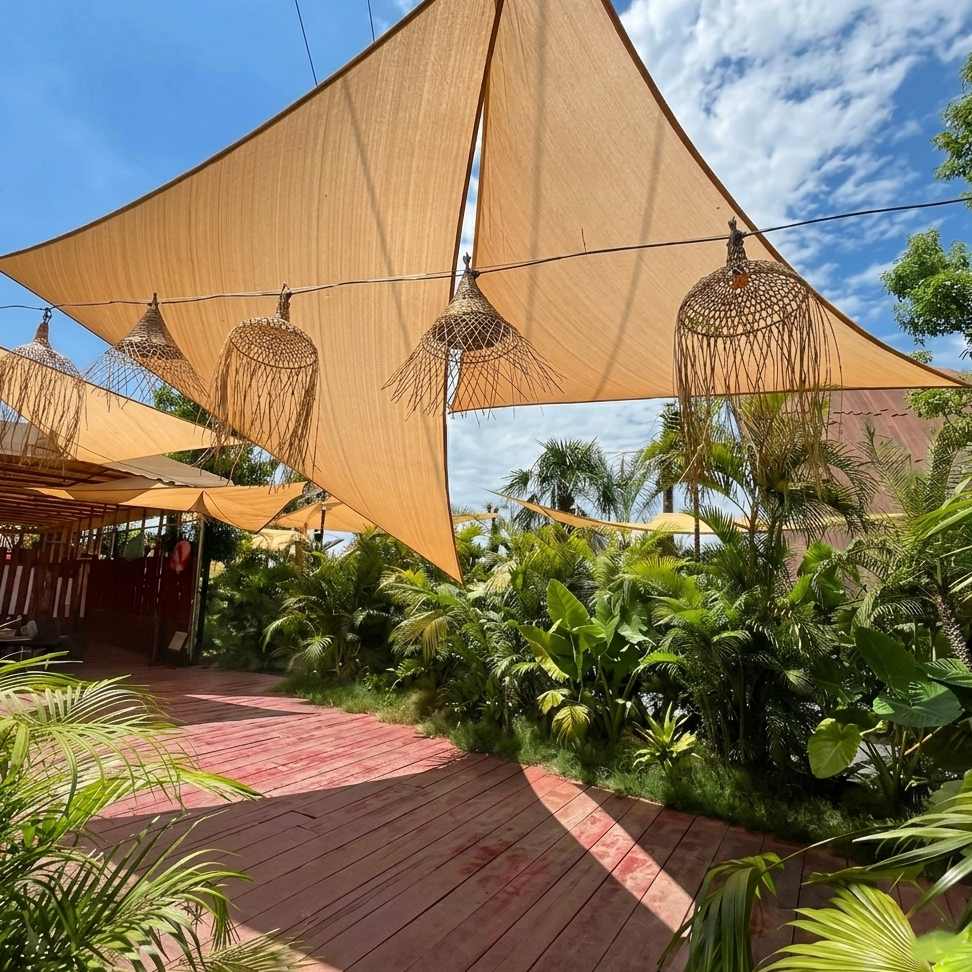
When sunlight becomes too strong, covering an outdoor area with a solid material is not always the best solution. Plants still need light, greenhouses need ventilation, and outdoor structures often need to remain open to air movement.
This is where HDPE shade net is commonly used.
Made from high-density polyethylene, HDPE shade net is a mesh material designed to reduce direct sunlight while allowing air to pass through. Depending on its construction and shade level, it can be used in greenhouses, agriculture, nurseries, gardens, parking areas and other outdoor shading applications.
For buyers and distributors, however, choosing a shade net is not simply a matter of selecting a color or a shade percentage. Material, mesh construction, UV stabilization, weight, width and the intended application all need to be considered.
What Is HDPE Shade Net?
HDPE shade net is generally made from high-density polyethylene yarns or tapes and produced in an open mesh construction.
Unlike solid fabrics, the open structure allows air to move through the material. At the same time, the mesh reduces the amount of direct sunlight reaching the area underneath.
HDPE is widely used for outdoor netting because of its combination of lightweight construction, flexibility and resistance to outdoor conditions. Shade nets can be manufactured in different weights, widths, colors and shading levels to suit different applications.
This flexibility is one reason HDPE shade net has become a common material for both agricultural and general outdoor shading projects.
A greenhouse may require moderate shading to reduce excessive solar radiation during hot periods, while a parking structure or outdoor shelter may require a much higher level of shade.
The right specification therefore depends largely on what the material is being used for.
How Does HDPE Shade Net Work?
The principle behind shade netting is relatively simple.
Instead of completely blocking sunlight, the mesh reduces the amount of sunlight passing through the covered area. At the same time, the open construction allows air to circulate.
Two specifications are particularly important when evaluating a shade net: shade percentage and UV resistance.
Understanding Shade Percentage
Shade percentage describes the amount of sunlight that the shade net is designed to reduce.
For example, a 30% shade net generally allows more light to pass through than a 70% shade net. A higher shade percentage provides stronger sunlight reduction, but that does not necessarily mean it is the better option.
For agricultural applications, plants have different light requirements. A shade level that works well for one crop may not be suitable for another.
Greenhouse design, geographical location, season and local sunlight conditions can also influence the selection.
For this reason, shade percentage should be considered together with the actual application rather than treated as a simple measure of product quality.
UV Stabilization
Because HDPE shade net is often used outdoors, exposure to sunlight over an extended period is an important consideration.
UV stabilization can help improve the material's resistance to long-term ultraviolet exposure. However, UV resistance should not be confused with UV blocking.
A shade net may reduce solar radiation because of its mesh construction, while UV stabilization is related to how well the material itself withstands UV exposure.
For commercial projects, buyers should therefore ask for the manufacturer's technical information regarding UV stabilization and outdoor performance rather than relying only on general claims.
Common Applications of HDPE Shade Net
HDPE shade net is used across several markets. Although the basic material is similar, the requirements can be quite different depending on the application.
Greenhouse Shade Net
Greenhouses are one of the most common applications for shade netting.
Too much sunlight can increase temperatures inside a greenhouse and create a growing environment that is difficult to control. Shade net can be installed over the greenhouse or used as part of the shading system to reduce direct solar radiation.
The main consideration is finding a suitable balance between light reduction and ventilation.
The correct shade percentage depends on the crop, greenhouse structure, climate and season. There is no single shade level that is suitable for every greenhouse.
For growers, it is usually more useful to consider the complete growing environment rather than selecting a shade net based only on its percentage.
Agriculture and Horticulture
HDPE shade net is also widely used in agriculture and horticulture.
It can be used for crop protection, plant nurseries, young plants and other areas where excessive sunlight needs to be reduced.
In these applications, the mesh structure is useful because it provides shade without creating a completely enclosed environment.
Depending on the crop and local conditions, different shade levels can be selected.
For commercial agricultural projects, factors such as installation method, roll width, edge reinforcement and expected outdoor exposure should also be considered.
Nurseries and Garden Applications
Plant nurseries often require different shading conditions from open agricultural fields.
Young plants and certain ornamental plants can be sensitive to strong direct sunlight. Shade net can provide a more controlled environment while maintaining air circulation.
The material is also used in gardens, landscaping projects and plant-growing areas where a lightweight shading solution is required.
Outdoor Shading and Parking Structures
The use of HDPE shade net is not limited to agriculture.
Higher-shade mesh can also be used for outdoor shelters, parking areas, walkways, recreational spaces and other structures where protection from direct sunlight is required.
For these projects, appearance and installation can become just as important as shade performance.
The mesh may need to be supplied in specific colors, widths or dimensions, and reinforced edges may be required depending on the structure.
How to Choose the Right HDPE Shade Net
There are several specifications worth checking before purchasing HDPE shade net for a commercial project.
Start With the Application
The first question should always be: Where will the shade net be used?
A greenhouse, nursery, agricultural field and parking structure do not necessarily require the same product.
For greenhouse applications, light transmission and ventilation are important.
For parking and outdoor structures, shade level, appearance, tensile strength and installation may be more important.
Starting with the application makes it easier to determine which specifications actually matter.
Consider the Shade Percentage
Once the application is clear, the appropriate shade percentage can be considered.
Lower shade percentages allow more sunlight through, while higher percentages provide stronger shading.
For plants, the selection should take into account the crop's light requirements and the local climate.
For general outdoor shading, the choice may depend more on the desired level of comfort and solar protection.
Choosing the highest shade percentage available is therefore not always the best approach.
Check the Material and UV Stabilization
For outdoor use, it is important to understand what type of HDPE material is being used and whether the product has been UV stabilized.
This can be especially important for customers in regions with strong sunlight and long outdoor exposure.
When comparing suppliers, it is better to ask for technical specifications rather than relying on descriptions such as "long-lasting" or "UV resistant" without supporting information.
Look at Weight and Mesh Construction
GSM is another specification commonly used when comparing shade nets.
However, weight alone does not tell the complete story.
Mesh construction, yarn or tape characteristics, density and manufacturing method can all affect the physical properties of the finished net.
Two products with similar shade percentages may therefore perform differently depending on how they are manufactured.
Check Width and Roll Length
For large projects, roll width can have a direct effect on installation.
Wider rolls can reduce the number of seams required in some applications, while standard roll lengths can make transportation and inventory management easier for distributors.
These details are often overlooked when comparing products, but they can make a difference once the material reaches the installation site.
Consider Edge Finishing
The edge of a shade net can be reinforced depending on how the material will be installed.
For larger structures, reinforced edges, hems, eyelets or other finishing options may be required.
The finishing should be discussed with the supplier before production, particularly for custom projects.
What Shade Percentage Is Best for Agriculture?
This is one of the most common questions when buying shade net, but there is no universal answer.
A lower shade percentage allows more sunlight to reach the plants. A higher shade percentage provides greater reduction of direct sunlight.
The appropriate choice depends on the crop, local climate, growing season and structure.
For example, a plant nursery with young plants may have different requirements from an outdoor agricultural application. Likewise, a greenhouse located in a hot, high-solar-radiation region may require a different shading solution from one in a cooler climate.
It is therefore better to determine the light requirements of the application first and then select the shade percentage.
In practical terms, more shade does not automatically mean better shade.
The objective is to provide the appropriate amount of sunlight reduction while maintaining the conditions required by the application.
HDPE Shade Net vs. Solid Outdoor Fabric
HDPE shade net and solid outdoor fabrics serve different purposes.
A solid fabric provides a more continuous barrier and may be more appropriate when waterproofing or complete coverage is required.
HDPE shade net has an open mesh structure. It is more suitable when sunlight reduction and airflow are both important.
This difference is particularly relevant in agriculture and greenhouse applications, where completely blocking air movement is generally not desirable.
For outdoor structures, the decision may depend on several factors, including shade, ventilation, waterproofing, appearance and installation requirements.
The two materials should therefore not necessarily be viewed as direct substitutes. The better option depends on the requirements of the project.
What Should Buyers Ask an HDPE Shade Net Supplier?
When comparing suppliers, a product photo and unit price are rarely enough to evaluate a shade net properly.
A commercial inquiry should normally cover several basic specifications.
Ask what type of HDPE material is used and whether the product is UV stabilized.
Confirm the available shade percentages and understand how they are measured.
Ask about GSM, mesh construction, available widths and standard roll lengths.
For project applications, check whether reinforced edges, hems, eyelets or other finishing options are available.
It is also useful to request samples before placing a large order. A physical sample allows buyers to check the mesh structure, color, weight, flexibility and general appearance before moving to bulk production.
For distributors, a complete technical specification sheet can also make it easier to compare products from different manufacturers.
Why HDPE Is Commonly Used for Shade Netting
HDPE is a practical material for shade netting because it can be manufactured into lightweight mesh structures while providing the flexibility required for outdoor applications.
The material can be processed into different yarn or tape constructions, allowing manufacturers to develop shade nets for different levels of shading and different end uses.
Its relatively low weight is also useful when large areas need to be covered.
However, the final performance of a shade net depends on more than the polymer itself. Manufacturing quality, UV stabilization, mesh construction and finishing all contribute to the characteristics of the finished product.
This is why specifications should always be considered as a complete package rather than focusing on one number.
Final Thoughts
HDPE shade net is a relatively simple material, but selecting the right product requires a clear understanding of the application.
For greenhouses and agriculture, the main consideration is often the balance between sunlight reduction and airflow. For parking areas and outdoor structures, other factors such as shade level, appearance, dimensions and installation can become equally important.
Shade percentage is an important specification, but it should not be the only one.
Material, UV stabilization, GSM, mesh construction, width, roll length and edge finishing can all affect the suitability of a shade net for a particular project.
For buyers, distributors and contractors, starting with the intended application is usually the most practical way to select the right product.
A well-matched HDPE shade net does not simply provide more shade. It provides the right level of shade for the environment in which it is going to be used.
Frequently Asked Questions
Is HDPE shade net suitable for greenhouses?
Yes. HDPE shade net is commonly used for greenhouse and nursery applications because its open mesh structure can reduce direct sunlight while allowing air to circulate.
The appropriate shade percentage depends on the crop, greenhouse design, climate and growing conditions.
What is HDPE shade net used for?
HDPE shade net is used for greenhouse shading, agriculture, horticulture, nurseries, gardens, landscaping, parking shade and other outdoor applications where sunlight needs to be reduced without completely blocking airflow.
What shade percentage should I choose?
There is no single shade percentage suitable for every application.
Lower percentages allow more light to pass through, while higher percentages provide greater sunlight reduction. The appropriate level depends on the crop, climate, structure and intended use.
Is HDPE shade net UV resistant?
HDPE shade net intended for outdoor applications can be manufactured with UV stabilizers to improve resistance to prolonged sunlight exposure.
However, the actual UV performance depends on the material formulation, stabilization system, construction and exposure conditions. Buyers should refer to the manufacturer's technical specifications.
Can HDPE shade net be used outdoors?
Yes. HDPE shade net is widely used outdoors for agriculture, greenhouses, nurseries, parking areas, gardens and shade structures.
For long-term outdoor use, material quality and UV stabilization are important considerations.
What is the difference between HDPE shade net and shade cloth?
The terms can overlap in the market. "HDPE shade net" generally describes a shade material made from HDPE with an open mesh construction, while "shade cloth" is a broader term that can refer to different shading materials.
The actual construction and performance should be checked in the product specification rather than relying only on the product name.
Share:
PVC Fabric for Bags: How Manufacturers Choose the Right Material
Why Does PVC Coated Fabric Become Sticky? Understanding Plasticizer Migration