
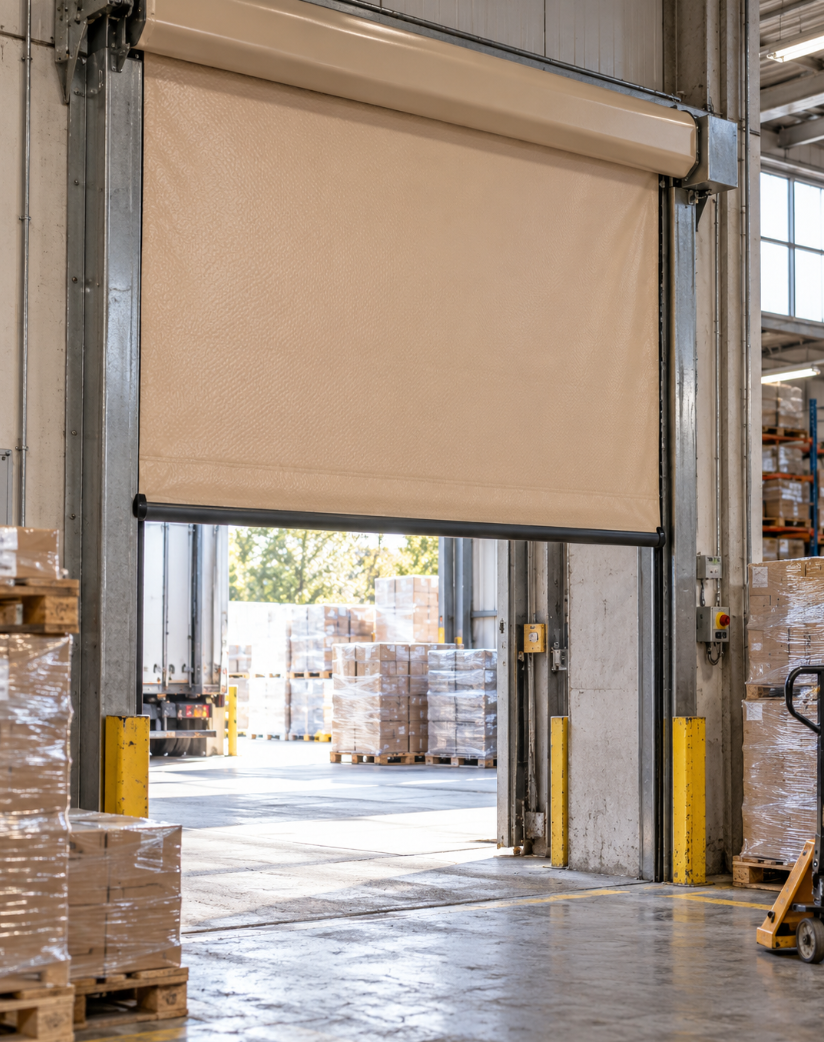
A flexible industrial door has to open and close repeatedly without disrupting the work around it. Its curtain is only one part of the door system, but the fabric choice affects how the curtain is made, fitted and used.
That is why buying by weight alone can lead to the wrong specification. Before placing an order, door manufacturers and fabricators should look at the door design, operating conditions, fabrication method and the performance evidence required for the finished application.
Start with the door design
“Industrial door” covers more than one construction. Some systems use a flexible fabric curtain that rolls above the opening; others use a different curtain or panel design. Even among roll-up doors, the fabric may be guided, tensioned and reinforced in different ways.
Confirm how the material will be used before discussing a grade. Is it for an internal partition or an exterior opening? How wide and high is the finished curtain? How often will it operate? Will it include vision panels, reinforced edges or a weighted bottom section?
These details help the supplier and fabricator assess whether the proposed width, construction and surface are suitable for the door system. A fabric specification should support the complete curtain design, rather than being selected in isolation.
Look beyond fabric weight
Weight per square metre is useful for comparing materials, but it does not describe the full construction. Two fabrics with similar weights can differ in base-cloth structure, coating, thickness, flexibility and strength.
For a door curtain, review the properties that matter to the way it will be converted and used. These may include tensile and tear strength, coating adhesion, dimensional stability, surface finish and flexibility in the expected temperature range. The required values should come from the door design and the buyer’s own application criteria.
Ask for the technical data for the exact grade being quoted. Avoid relying on a general product-family figure if the order will use a different weight, width or finish.
Confirm the fabrication method
The fabric has to be turned into a finished curtain. Depending on the design, this may involve welded seams, edge reinforcement, pockets, hardware attachment or transparent sections. The converter’s equipment and process affect which construction is appropriate.
Before ordering production volume, agree on the seam layout and fabrication method with the door manufacturer or curtain fabricator. Test a representative sample using the intended process. Check the finished seam and attachment areas, not only the unprocessed fabric, because these are part of the curtain that will be installed and operated.
If the design includes windows or vision panels, confirm how they will be positioned and joined to the main curtain. Their size and placement should suit the finished door and its operating environment.
Match the specification to the operating environment
A curtain used inside a dry warehouse faces different conditions from one installed at an exterior opening. Consider temperature, sunlight, moisture, dust, cleaning routines and the chance of contact with vehicles or equipment. State these conditions clearly when requesting a quotation.
If the project requires flame-retardant or antistatic performance, name the requested standard or test requirement. Do not treat different classifications as interchangeable. Ask for documentation that applies to the specific fabric grade and intended use, and confirm whether the requirement applies to the fabric, the finished curtain or the complete door system.
The finished door also includes its guides, frame, drive and safety controls. Fabric data alone does not establish the performance of an installed door. The door system manufacturer or project specifier should confirm the requirements for the complete assembly.
Check consistency for repeat orders
A sample may look right, but production buyers also need consistency across rolls and repeat orders. Confirm the required width, weight, color, surface finish, roll length and packaging before production. Agree how the supplied goods will be identified and checked against the approved specification.
For a new project, keep an approved reference sample and record the grade and finish. This gives both the fabric supplier and the fabricator a clear point of comparison if the project is reordered or adjusted later.
Information to include in an RFQ
A useful inquiry gives the supplier enough information to assess the application. Include:
- Door type and whether the opening is indoors or outdoors
- Finished curtain dimensions and required fabric width
- Expected operating conditions, including temperature and exposure
- Required weight, thickness, color and surface finish, if specified
- Fabrication process and any seam, reinforcement or window requirements
- Required flame-retardant or antistatic standard and supporting documents
- Estimated order quantity and repeat-order expectations
If some details are not yet fixed, send the available drawings, a reference sample or the door system requirements. The fabricator can then confirm which information is still needed before production begins.
Frequently asked questions
What weight is best for PVC industrial door fabric?
There is no single weight that suits every door. The correct specification depends on the door construction, opening size, operating conditions and project requirements. Compare the technical data for the exact grades under consideration.
Can I specify the fabric without knowing the welding process?
It is better to confirm the fabrication method before ordering production material. Ask the curtain fabricator to test a representative sample using the intended equipment and seam design.
Does a fabric test report certify the complete industrial door?
No. A fabric report describes the tested material and properties. The complete door includes other components and must be assessed against the requirements for the finished system and its installation.
Specify the curtain for its real operating conditions
A reliable industrial door curtain starts with a clear brief: the door design, operating environment, fabrication method and required evidence. Weight matters, but it is only one part of that decision.
UCTEXTILE supplies PVC industrial door fabric with specification options that can vary by grade, including customized color and weight. Flame-retardant classifications and antistatic options should be confirmed for the selected product. For a quotation, share the application, target specifications and estimated volume.
Share:
PVC Mesh Open Area vs. Shade: What Buyers Should Check
PP Sunscreen Fabric Sample Evaluation Guide