
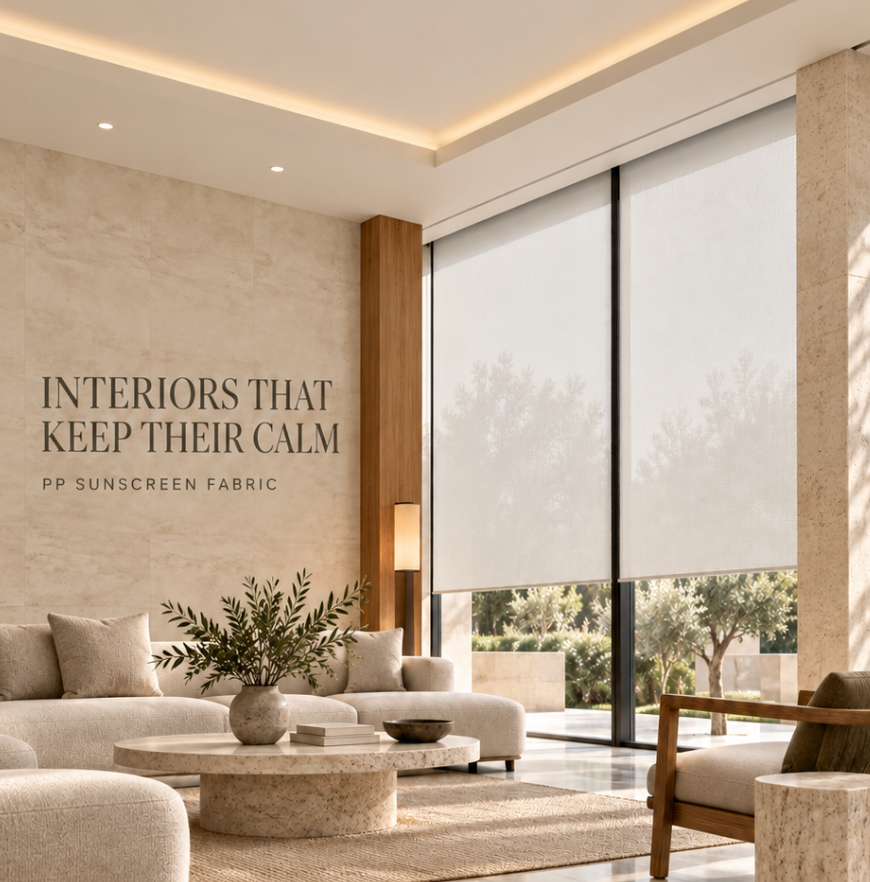
A sunscreen fabric sample is easy to underestimate.
On a desk, it is a small piece of material with a colour, a grid and a number beside it. Once it becomes part of a roller shade, it affects the room, the window, the finished system and the customer's perception of the collection. That is why a sample review should be more than a quick check of colour and openness.
For shade manufacturers, distributors and project teams, the useful question is not simply, “Does this fabric look good?” It is, “Will this material make sense in the finished shade program we are developing?”
PP Sunscreen Fabric from uctextile is a PVC-free material designed for interior solar-control shade systems. It uses PP yarn with a TPO coating and a full basket-weave construction. Before it is specified for a roller shade collection, Roman shade, panel track or project package, it should be reviewed in the context in which it will actually be used.
Start With the Finished Shade, Not the Swatch
The first decision should be about the finished application.
Is the fabric intended for a residential roller shade collection, a hospitality project, a meeting room, or a commercial fit-out? Will it be fitted in an open roller system, a cassette system, a panel track or another format? Will the customer be comparing it with a PVC sunscreen fabric, a decorative blind fabric or another solar-control material?
These questions change what should be examined in the sample. A fabric chosen for a clean, minimal residential range may be reviewed differently from one intended for a large office-shade program. The visual standard, required colour range, preferred openness and system compatibility may all be different.
Before ordering samples, it helps to prepare a short project brief:
- intended shade system;
- interior application and market;
- preferred colour direction;
- target openness range;
- usable fabric width and roll length;
- expected order volume; and
- any project-specific documentation requirements.
This gives the supplier enough context to recommend a suitable starting point rather than sending a random group of swatches.
Look at the Fabric in Natural Light
Colour charts remain useful, but a screen image or a printed catalogue cannot replace a sample held against a real window.
Place the sample near the glass, then move it against a light wall and a darker background. Look at it in morning or afternoon daylight, not only under showroom lighting. A neutral shade can appear warmer, cooler or more transparent depending on the light behind it and the finishes around it.
This is also the right moment to assess the surface character. PP sunscreen fabric has a woven appearance, and the rhythm of that weave becomes more visible at close range and less visible at normal viewing distance. A good sample review considers both. A fabric may look highly textured when held in the hand but read as quiet and uniform once it is installed across a window.
For a collection rather than a one-off project, ask to compare more than one cutting from the same specification. This is a practical way to discuss the required level of visual consistency before production is planned.
Treat Openness as a Design Decision, Not a Ranking System
PP Sunscreen Fabric is available in 1%, 3% and 5% openness options. It is tempting to treat these figures as “more” or “less” product, but that is not how a buyer should use them.
Openness is one part of the relationship between daylight, privacy and the view through the shade. The appropriate choice depends on the room, the orientation of the window, the visual target of the collection and the expectations of the final user.
A useful sample exercise is to place different openness options at the same window and compare them from both sides of the glass. Instead of asking only which option looks most open, ask:
- How does the room feel with the shade in place?
- How much connection to the outside is desired?
- Is the product intended for a more private setting, a hospitality interior or a shared office environment?
- Does the selected colour change the perceived density of the fabric?
The purpose of this exercise is not to make a universal claim about one openness level. It is to identify the version that best matches the intended finished shade.
Check the Material Against the Shade System
A fabric can be visually suitable and still require further review before it enters a shade program.
The material should be assessed with the actual hardware and fabrication approach wherever possible. Consider the roller diameter, bottom bar, cassette or exposed system, cutting method and the handling expected during production. For panel tracks and Roman shades, the construction method may introduce different considerations from a standard roller shade.
At this stage, the fabricator or system supplier should confirm fit with the selected hardware. A material supplier can provide product information and samples; the finished-system performance should be evaluated using the actual system configuration.
This distinction matters. It keeps the specification process realistic and prevents a sample review from becoming an unsupported promise about every possible finished shade.
Ask for the Information That Is Relevant to the Project
The best sample requests are specific. Rather than asking only for “solar screen fabric,” provide the details that affect the recommendation.
For PP Sunscreen Fabric, the conversation may include the desired openness, colour, usable width, roll configuration, application and estimated quantity. If the project has a particular compliance, testing or documentation requirement, mention it early. Requirements should be confirmed against the exact product specification and destination market rather than assumed from a general product description.
It is also sensible to keep visual and technical questions separate. A sample can help a buyer review colour, woven appearance and light response. It does not, by itself, verify every project requirement. Claims relating to flame performance, acoustic behaviour, exterior weathering, recycling routes or chemical exposure should be supported by product-specific documents and evaluated for the intended use.
Sample Reviews Work Best When They Are Shared
In many shade programs, the final decision is made by more than one person. A product manager may focus on the collection. A fabricator may focus on handling. An architect or designer may focus on the room. A distributor may need a clear story that sales teams can explain without overstating the material.
For that reason, it is useful to keep the sample review simple and shareable. A small comparison board can include the sample, openness, intended system, proposed colour name and notes from the window test. This gives everyone a common reference before a specification is fixed.
The process is especially helpful when a collection is moving toward PVC-free material options. The material choice should feel deliberate, not like a last-minute substitution. A well-reviewed sample gives a team a clearer basis for discussing the final product range, customer expectations and next development step.
From Sample to Specification
The strongest material decisions are usually made before the first production roll is ordered.
Review the PP sunscreen fabric sample in real light. Compare the intended openness options. Discuss the selected shade system. Confirm the practical details that affect fabrication and supply. Then move forward with a specification that reflects the finished project rather than a single swatch on a desk.
uctextile supports B2B product development for interior solar-control shade systems. To request PP Sunscreen Fabric samples or technical information, share your intended application, preferred openness, target colour, required width, estimated quantity and destination market.
Frequently Asked Questions
Is PP Sunscreen Fabric the same as PVC sunscreen fabric?
No. uctextile PP Sunscreen Fabric uses PP yarn with a TPO coating and is PVC-free. It should be evaluated on its own material construction, appearance and suitability for the intended shade system.
Can a sample confirm the final colour?
A sample is the best starting point for colour review, especially when checked in the actual interior light. For production planning, confirm the exact product specification and available colour options with the supplier.
Is PP Sunscreen Fabric intended for exterior roller shades?
This product is positioned for interior solar-control applications. Exterior systems have different exposure and system requirements and should be evaluated separately.
What should be included in a PP sunscreen fabric enquiry?
Include the intended shade system, application, preferred openness, colour direction, required width, expected quantity, destination market and any documentation requirements.
Share:
PVC Industrial Door Fabric: A Buyer’s Specification Guide