
When buyers ask for a coated fabric by weight, the conversation often begins with one number: GSM.
It is a useful starting point, but it is not a complete specification.
For outdoor covers, shelters, pergolas and transport applications, fabric weight is only one part of the decision. A lower-weight material may reduce handling and installation effort, but only when the base fabric, coating structure, welding method and intended use have been considered together. The same is true at the heavy-duty end of the range: choosing more GSM than the application requires can add unnecessary bulk, cost and fabrication difficulty.
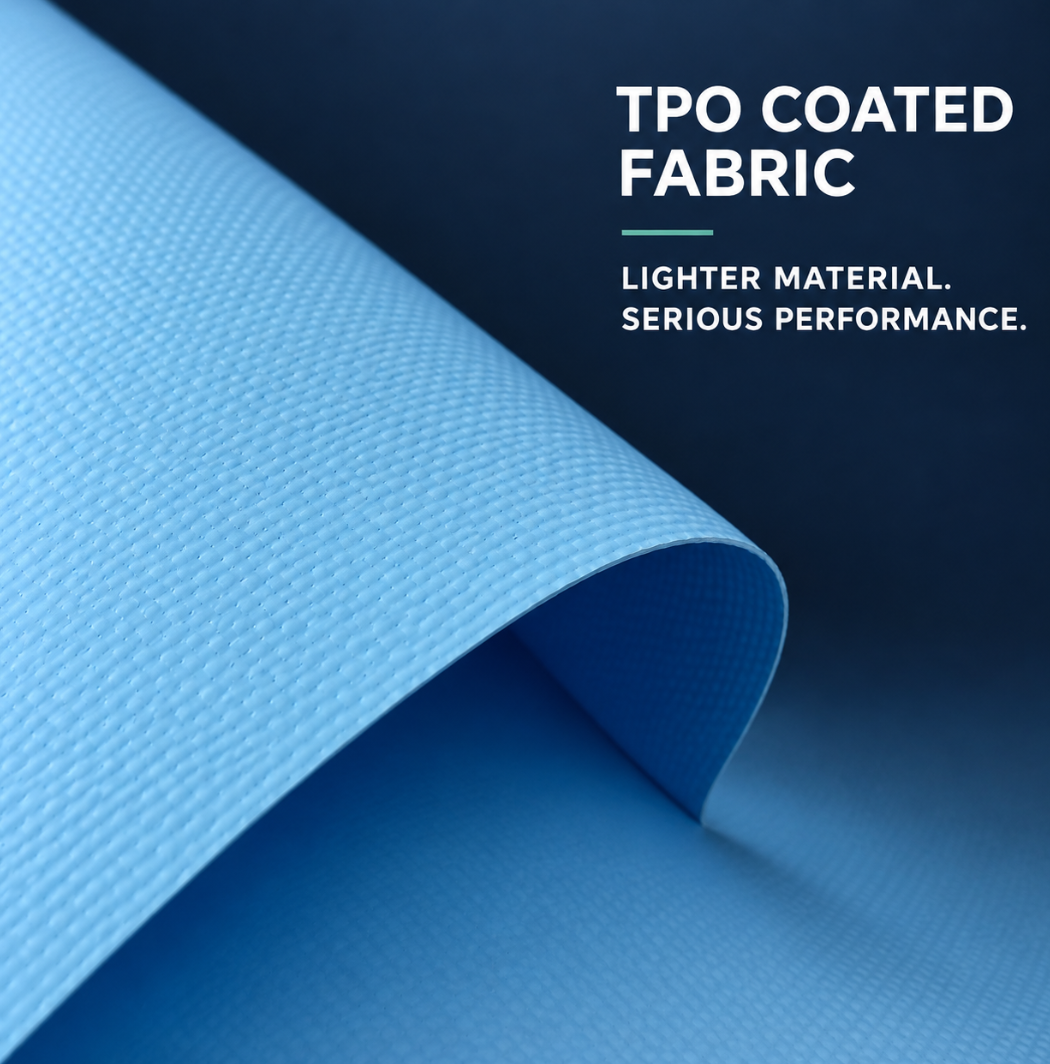
This is especially important when specifying TPO coated fabric. TPO gives manufacturers a PVC-free material option for outdoor applications, but it should be selected as an engineered material system—not simply as a lighter roll.
Start With the Finished Application
The best TPO specification begins with the finished product rather than the material roll.
A cover that is frequently opened, folded or installed by hand has different priorities from a fixed pergola roof. A temporary shelter has different loading conditions from a truck cover. Before selecting a GSM level, define the job the fabric will perform:
- Will the finished product be folded, rolled or tensioned?
- Is it a temporary cover, a semi-permanent structure or a transport product?
- Does the application need light transmission or blackout performance?
- Will the fabric be fabricated mainly by hot-air or hot-wedge welding?
- What width, colour, surface finish and annual volume are required?
- Are there project-specific fire, weathering or other test requirements?
These questions prevent a common mistake: specifying a fabric that looks suitable on paper but creates unnecessary challenges during fabrication or installation.
GSM Is a Starting Point, Not a Performance Guarantee
GSM describes fabric mass per square metre. It does not tell the full story about reinforcement, coating balance, flexibility or seam behaviour.
Two coated fabrics can have a similar weight and still perform differently because their yarn construction, scrim density, coating formulation and intended application are different. For that reason, buyers should look at GSM together with fabric construction and the demands of the finished product.
For uctextile’s TPO range, the product families are organised by application:
Lightweight TPO Coated Fabric — 260gsm
A practical option where easier handling and lower material weight are important. It is suited to lightweight coverings and selected outdoor protection applications where the finished product does not require a heavy structural fabric.
TPO Covering Fabric — 380gsm, 400gsm, 420gsm and 450gsm
These grades use a 1000D × 1000D, 20 × 20 PP base fabric. They are designed for outdoor covering applications where buyers need a stronger construction without moving directly into a heavier tent or truck-cover specification.
TPO Tent & Pergola Fabric — 500gsm
This range uses a 1000D × 1000D, 23 × 23 base fabric and is available in blackout and non-blackout options. It is intended for tents, pergolas, awnings and outdoor shelter systems where light control and finished appearance matter alongside fabric strength.
Heavy Duty TPO Truck Cover Fabric — 610gsm
For transport covers and heavier outdoor applications, the specification must account for repeated handling, fabrication requirements and the demands of the finished cover system.
The correct choice is not automatically the lightest or the heaviest option. It is the grade that matches the real load, fabrication method and expected use of the finished product.
Lightweight Should Reduce Burden, Not Confidence
“Lightweight” is often treated as a marketing word. In practice, it should mean something more useful.
A well-selected lighter TPO coated fabric can reduce the burden of transporting rolls, moving material around the workshop and handling the finished product on site. For manufacturers of outdoor covers, this can also make fabrication and installation more manageable.
However, lower weight should not mean that a buyer ignores reinforcement or seam design. The question is not simply whether a material weighs less than another option. The question is whether the fabric has the right construction for the intended application.
This is why TPO should be specified around the finished use. A pergola fabric may need a different balance of weight, light control and appearance from an industrial cover. A truck cover may require a different approach again. Treating every outdoor application as a generic “tarpaulin” project leads to poor specifications and avoidable revisions.
Base Fabric Construction Changes the Outcome
The scrim is not a hidden detail. It is part of the performance structure of a coated fabric.
In TPO coated fabric, the base fabric influences strength, dimensional behaviour, tear resistance and how the material responds during fabrication. Buyers should therefore request the base fabric construction as part of the technical specification—not after the initial quotation.
For example, uctextile’s Covering Fabric range uses a 1000D × 1000D, 20 × 20 PP base fabric, while the 500gsm Tent & Pergola Fabric uses a 1000D × 1000D, 23 × 23 construction. These are not interchangeable descriptions. They support different finished-product requirements.
When discussing a project, it is helpful to provide the fabricator with more than a target GSM. Share the intended application, expected handling, finished dimensions, welding method and any requirements for light transmission or blackout. This gives the supplier a basis for recommending a suitable construction rather than simply quoting the nearest available weight.
Confirm Welding Compatibility Early
A coated fabric can be technically suitable for an application and still cause problems if it does not fit the fabricator’s equipment or process.
TPO coated fabric is commonly processed using hot-air or hot-wedge welding. The exact settings, overlap design and production method should be confirmed through sample trials before production begins. This is particularly important for larger covers, tent roofs, pergola systems and products where seam quality affects the finished appearance.
Welding should not be left until the end of the specification process. It should be discussed at the same stage as weight, colour and width.
For buyers who are developing a new product line or changing from another coated-fabric system, sample welding trials are one of the fastest ways to assess whether the material and production method are aligned. A proper trial can reveal practical details that a datasheet alone cannot show.
Light Control and Project Requirements Need Their Own Specification
For pergolas, tents and shading systems, “outdoor fabric” is often too broad a description.
Some applications need light transmission. Others need blackout performance. Some projects require a particular surface appearance, while others focus on function and ease of fabrication. These requirements should be written into the enquiry rather than assumed from the fabric weight.
The same principle applies to fire-retardant, weathering or project-specific test requirements. These are product- and application-dependent. They should be confirmed against the relevant technical data and test reports for the selected construction, rather than carried over from a different fabric grade.
This approach is more reliable for both buyers and suppliers. It avoids overclaiming and keeps the final product aligned with the actual project requirement.
A Better Way to Request a TPO Fabric Quotation
A clear enquiry produces a more useful quotation and reduces the number of specification changes later. When requesting TPO coated fabric for outdoor covers, provide the following information:
- Finished application and end market
- Required GSM or preferred product family
- Required width and colour
- Light-transmitting or blackout requirement
- Expected welding method and available equipment
- Any fire, weathering or project test requirements
- Estimated order quantity and purchasing schedule
With this information, a supplier can recommend an appropriate TPO coated fabric construction and provide a more relevant technical discussion.
Choose the Material Around the Job
TPO coated fabric is not defined by one number, one application or one sustainability claim. Its value comes from selecting the right balance of weight, reinforcement, fabrication compatibility and outdoor-use requirements.
For buyers developing covers, tents, pergolas or transport products, GSM should begin the conversation—not end it.
Uctextile supplies TPO coated fabric for outdoor covering and protection applications, with product options developed around lightweight covers, general covering, tent and pergola systems, and heavy-duty truck covers. For a project-specific recommendation, share your application, required specification and annual volume with our technical team.
Share:
Why Does PVC Coated Fabric Become Sticky? Understanding Plasticizer Migration