
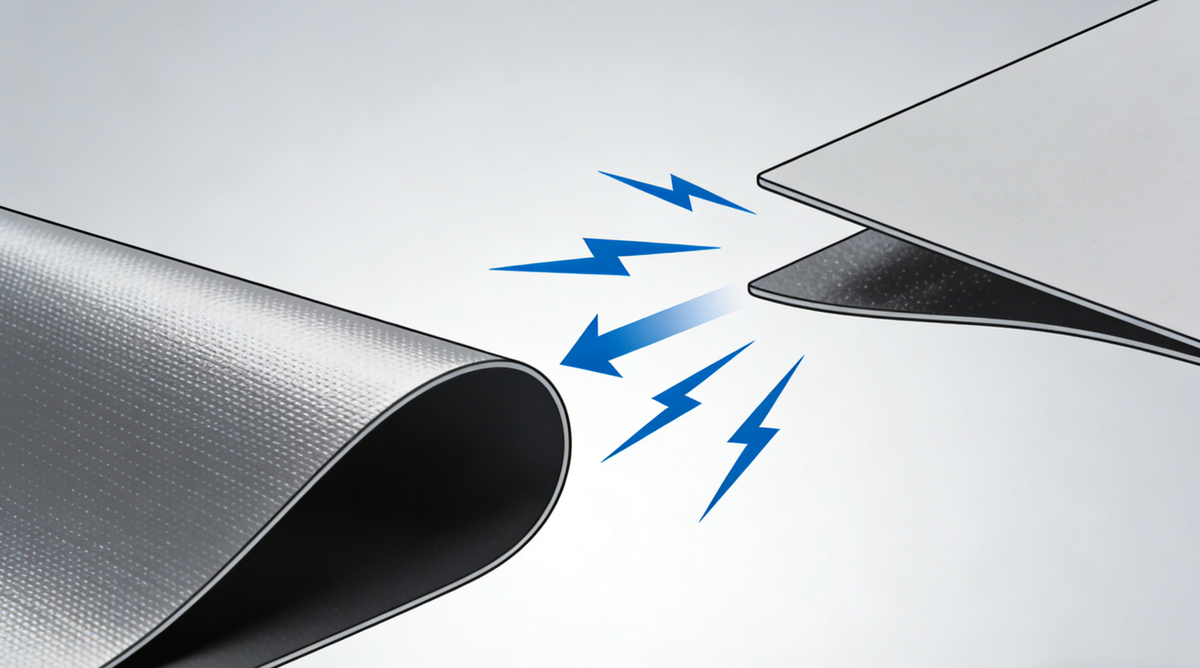
Static electricity is an often underestimated performance factor in coated fabrics. While it is not visible and rarely listed as a standard specification, static buildup can directly affect handling, cleanliness, safety, and long-term material stability.
Understanding Static in Coated Fabrics
Static electricity forms when electrical charges accumulate on the surface of a material without an effective path to dissipate. Most coated fabrics, including PVC-coated and TPO-coated fabrics, are inherently insulating. During production, transportation, installation, and daily use, static charges are generated through:
- Friction between fabric surfaces
- Repeated folding and rolling
- Contact and separation from other materials
- Airflow over large coated surfaces
- Low ambient humidity
Because these charges are not visible, static problems are usually identified only after performance issues appear.
Practical Impacts of Static Buildup
Surface Contamination
Static-charged coated fabrics attract airborne dust and fine particles. This is particularly problematic for applications where surface cleanliness and appearance are critical, such as architectural membranes, exhibition structures, and industrial covers.
Handling Efficiency
High static levels increase surface adhesion, causing fabrics to cling to themselves or surrounding objects. This complicates handling, unfolding, and installation, especially in dry or cold environments.
Operational Safety
In industrial settings, static discharge can create discomfort for operators and may pose risks near flammable substances or sensitive electronic equipment. For large-area coated fabrics, uncontrolled static should be considered a potential safety hazard.
Material Durability
Repeated static discharge may contribute to localized surface stress. Over time, this can influence coating uniformity and accelerate surface aging, particularly in high-friction applications.
Why PVC and TPO Coated Fabrics Are Susceptible
PVC and TPO coatings provide excellent waterproofing, weather resistance, and mechanical stability. However, their polymer structures result in:
- High surface resistivity
- Limited electrical conductivity
- Strong charge retention under dry conditions
Without anti-static design measures, static accumulation is unavoidable in many use environments.
Anti-Static Engineering Approaches
Effective static control must be addressed at the material design stage. Common engineering solutions include:
Anti-Static Additives
Incorporating anti-static agents into the coating formulation reduces surface resistivity and allows gradual charge dissipation without compromising mechanical or weather-resistant properties.
Coating and Surface Optimization
Controlled coating thickness, surface morphology, and finishing processes help minimize charge concentration and reduce dust attraction.
Application-Oriented Material Design
Different end uses require different static performance levels. Industrial tarpaulins, architectural membranes, transportation covers, and temporary structures each demand tailored solutions based on their operating conditions.
When Anti-Static Performance Matters Most
Anti-static coated fabrics are especially important for applications involving:
- Dry or low-humidity climates
- Frequent handling and movement
- Large exposed surface areas
- Clean or controlled environments
- Industrial or safety-sensitive operations
Ignoring static performance often leads to avoidable complaints, inefficiencies, and safety concerns.
Static as a Quality Parameter
As coated fabric applications continue to evolve, static control should be evaluated alongside tensile strength, flame retardancy, UV resistance, and dimensional stability. It is not a cosmetic feature but a functional property that influences real-world performance.
At uctextile, PVC and TPO coated fabrics are engineered with comprehensive performance considerations, including static behavior under practical use conditions, to ensure reliability across diverse applications.
Static issues in coated fabrics are invisible but measurable in their consequences. Proper anti-static engineering improves handling, cleanliness, safety, and material longevity. For professional users and project-based applications, static control should be recognized as an essential quality parameter—not an optional feature.
Share:
The Ultimate PVC Tarpaulin Guide: Solving the 5 Most Common Real-World Problems
Cold Weather Performance of PVC Tarpaulin Systems